Guide to working at height safely


Working at height remains one of the biggest causes of deaths and serious injuries. The most common cases include falls from Stairs and through fragile surfaces. Working at height means working anywhere a person could fall from a distance that could cause personal injury if precautions are not taken.
At Liftisa, we are always focused on finding the best solution for our customers. Innovating and improving the product. We have a Large, new, modern fleet, of lifting platforms for people and material, from the best brands. Specialists in lifting platforms for low-height work. We are committed to offering companies solutions that improve the safety, productivity and efficiency of the equipment.
What is the legislation for work at height?
The aim of legislation for work at height is to prevent accidents that can lead to death and injury caused by a fall from a height. The regulation applies to everyone who employs or controls work at height. This could also include facility managers or building owners who may hire others to work at height.
The first step is for employers and those in control to assess the risks first. Factors to consider include task height, duration, and frequency. As well as the condition of the surface to be worked, whether it is indoor or outdoor.
The law says that you must ensure that:
- All work at height is planned and organized.
- People who work at height are competent and have received the appropriate training.
- The risks of working at height are assessed and the appropriate work equipment is used .
- The risks of working on or near fragile surfaces are properly managed.
- The equipment used for work at height is inspected and has been maintained .
Here you can find an online guide prepared by the National Institute for Occupational Safety and Health (INSST) to help comply with the safe use of equipment for work at height.
Good practices while working at height
How do you decide if someone is “competent” to work at height?
Those who work at height must have the relevant skills, knowledge and experience. If they are being trained, they should always work under the supervision of someone competent.
What can you do to protect your operators?
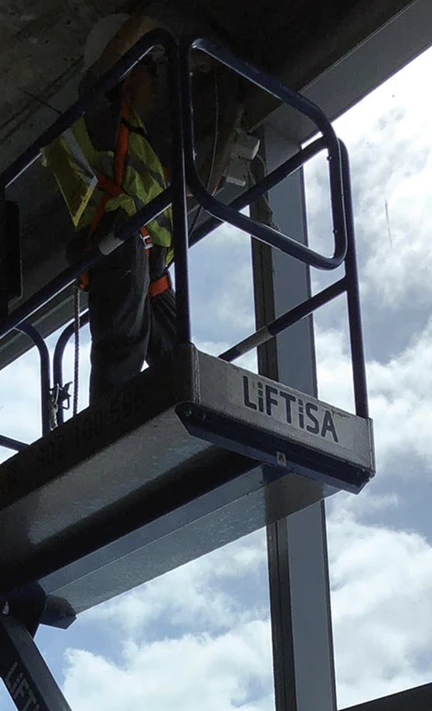
First, always consider measures that protect everyone at risk (collective protection) rather than measures that only protect at the individual level (personal protection). On the one hand, collective protection It is equipment that does not require the action of the person working at height to be effective, such as a railing. On the other hand Personal protection It is a team that requires the individual to act in order to be effective. An example would be correctly fitting a safety harness and connecting it to an anchor point with a lanyard.
What should be taken into account when planning work at height?
For your operators to work in the safest way, you must:
- Consider whether poor weather conditions could compromise worker safety.
- Verify that the place where the work is carried out at height be safe. Every time, before the work is done.
- Prevent materials or objects from falling. If it’s not practical To avoid falling objects, make sure to take the appropriate measures to avoid injuries, such as exclusion zones.
- Store materials and objects safely so that they do not cause injury if disturbed or collapsed.
- Develop an emergency and rescue plan.
The manager should always ensure that the emergency recovery plan is properly planned and that recovery drills have been practiced often.
How to ensure that the lifting platforms are in good condition?
Any platform used to perform work at height must be assembled or installed in accordance with the manufacturer’s instructions and in accordance with industry guidelines. At Liftisa we inspect and maintain our equipment after each rental.
Liftisa’s low-height access solutions
At Liftisa we are experts in lifting platforms and specialists in low-height access. From self-propelled lifting platforms to Manual Lifting Platforms. The latter are solutions that do not require a power source. Our wide range of low-height access machinery offers accessible, safe and efficient solutions to minimise the risks associated with working at height.
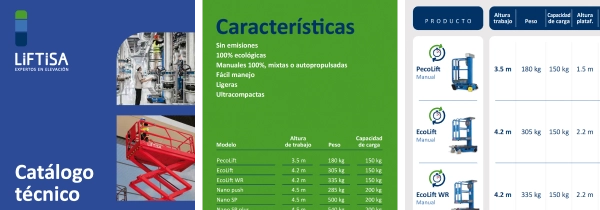
Download our catalog
You’ll be able to view all of our products and current offers, as well as the technical specifications and other services offered by LIFTISA so you have all the information you need for your project.