Do you work with MEWPs? Maintenance of lifting platforms.


Maintenance of MEWP platforms
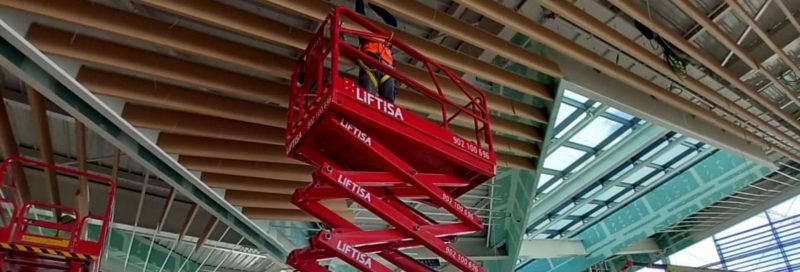
Scissor lifts are one of the most used platforms for working at height. Companies in the construction or industrial sector can own or rent them.
In all cases, the most important thing is to ensure that they have up-to-date maintenance, revisions and inspections to ensure the safety of the user and verify that the machine works with good performance.
While you don’t always feel like spending time on these tasks, users and site managers will find that it’s worth every minute if the scissor lifts are “ready to work” and still perform at their best.
Before starting to work with a scissor platform, the manager should check:
- Workplace inspection site inspection.
- Visual inspection of the platform.
- Functional test.
The platform has up-to-date maintenance. As well as the functional tests, as indicated in the machine operator’s manuals.
Workplace inspection.
A jobsite inspection helps the operator determine if the jobsite is a suitable and safe space to operate the scissor lift.
The operator must perform this inspection before moving the scissor lift to the job site.
The operator’s manual is a good resource for identifying the most common hazards that can be encountered on job sites, and it’s always a good idea to check with your site supervisor or safety manager about hazards unique to a particular job site.
In any workplace at height, scissor lift operators must be aware of the following dangerous situations and avoid them.
For example:
- Descents or holes
- Potholes, obstacles in the ground, or debris
- Sloped surfaces
- Unstable or slippery surfaces
- Obstructions at the top
- High voltage conductors
- Surface support inadequate to withstand all forces imposed by the machine
- Wind and adverse weather conditions
- The presence of unauthorized personnel
- All other possibly unsafe conditions
It is important for operators to always remember that it is their responsibility to read the guidelines for the daily maintenance of scissor lift platforms before starting work.
And remember workplace hazards, as well as monitor and avoid these risks while moving, installing, and handling MEWPs.
If in doubt, operators should stop work and consult the site supervisor or safety manager.
Visual inspection of the platform
The pre-operation inspection is a visual inspection that must be carried out by the operator before each work shift. This inspection is designed to find out if there is anything seemingly wrong with a machine before the operator performs the functional tests. Pre-operation inspection is also used to determine if routine maintenance procedures are required.
For example, the operator should inspect the wheels, lifting mechanism, and platform for any damage, which should be repaired before use.
Once repairs have been made, the operator should perform a pre-operation inspection again before moving on to functional testing.
Functional test
At LIFTISA, we believe that safety comes first. That’s why we believe that functional tests are designed to uncover any malfunctions before putting the machine into service.
The operator must follow the step-by-step instructions of the scissor lift manufacturer to test all the functions of the machine before they can start working at height.
It is important to know that you should never use a machine that works incorrectly. If a malfunction is discovered, the machine should be tagged and removed from service. Once repairs have been made, the operator must re-perform the pre-operation inspection and functional tests, before putting the machine into service.
Following a regular maintenance routine, including the important daily commissioning tasks outlined in the operator’s manual, helps ensure that a scissor lift is ready to work when needed.
Do you need the best advice on lifting platforms for your company?
We will advise you. We adapt to your needs to offer you the most suitable solution.
You can visit our website to make an appointment for a service or maintenance. Download 10 safety tips.
902 100 696
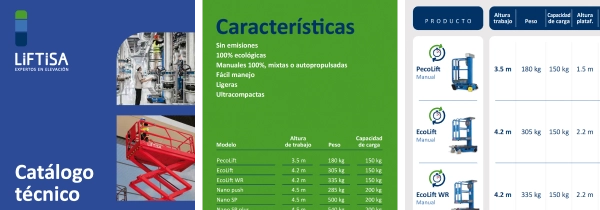
Download our catalog
You’ll be able to view all of our products and current offers, as well as the technical specifications and other services offered by LIFTISA so you have all the information you need for your project.