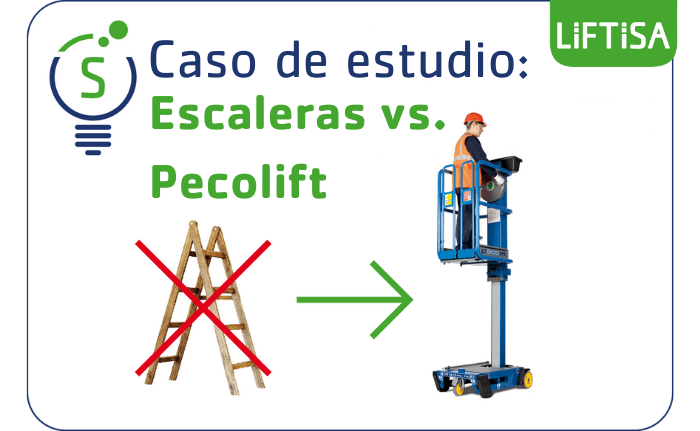
Case Study: Stepladder vs. Ladder Pecolift
Contextualization
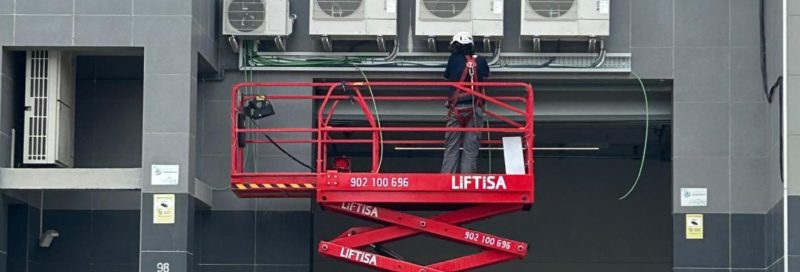
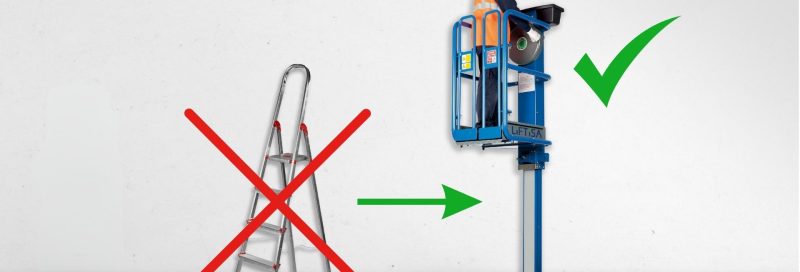
The ORP and Safety team of a German construction company carried out a study comparing work with ladders with an alternative means of access. Ladders are normally used for climbing up and down. When scaling, operators are hands-free, limiting their mobility. The Accidents involving these types of ladders are common incidents that lead to fall-related injuries.
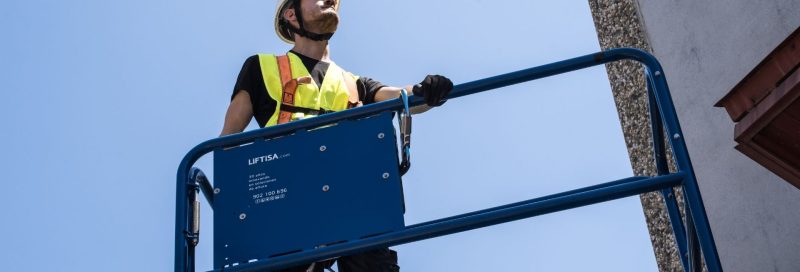
The most common injuries associated with ladder accidents are contusions, sprains, and strains, as well as closed fractures. The most affected areas of the body are the ankle, knee and foot. For this reason, the construction company, in collaboration with the company Power Towers, acquired Pecolift lifting platforms with the aim of Improve the safety of your workers when performing low-height work.
Participants
On the one hand, the German construction company It aimed to become the world’s most dynamic building services company by offering places that help people and businesses thrive. For nearly three decades, it has offered s Construction solutions to some of the world’s most successful and enduring companies, cities, and institutions. However, today’s fast-paced world demands more than just two hands free.
On the other hand, Power Towers Ltd., UK platform manufacturer founded in 2007. The company was instrumental in creating the low-rise platform industry. Six years later, in 2013, manual lifting platforms Pecolift and Ecolift were introduced as an innovative and unique solution in the UK as an alternative to ladders and scaffolding. It is about Low-rise lifting platforms recognized not only for improving safety, but also for their simplicity, efficiency, and improved ergonomics for operators.
Initial stage
In the initial stage of the development of the study, operators, engineers, ergonomists, project managers and safety were involved. In this way, it was ensured that, when the engineers made the designs, consider the operator and the use of the lifting platform in the development process. The low-rise platforms were designed and cycled to be durable. The latest technology of Motion Sensors to determine the forces that were applied to the operator’s body. In this way, they made sure that the machines were comfortable to use.
Case Study
-
Objective
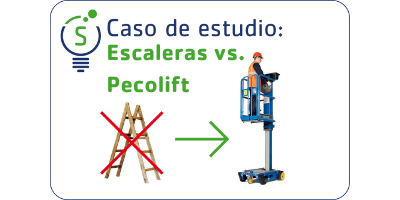
Replace ladders with alternative and modern machinery for work at low heights.
-
Definition of working at height
Work at any height above ground level, at ground level, or below ground level where a fall could result in injury.
-
Products Compared
Ladder vs. Pecolift.
-
Action Plan for the Prevention of the Use of Ladders
Together with Power Towers, an action plan was prepared on how to teach operators how to use the Pecolift low-rise platform lift and thus educate on how to implement this policy.
| 2018 | 90% use of ladders.
10% use of low-rise lifting platforms. |
| 2018 – 2019 | The construction company consulted operators and initiated specific training sessions. Implemented the policy of working at height with low-height lifting platforms and a conditional permit for the use of the ladder daily. |
| 2019 | 95% use of low-rise lifting platforms.
5% use of ladders. |
Conclusions of the use of Pecolift lifting platforms
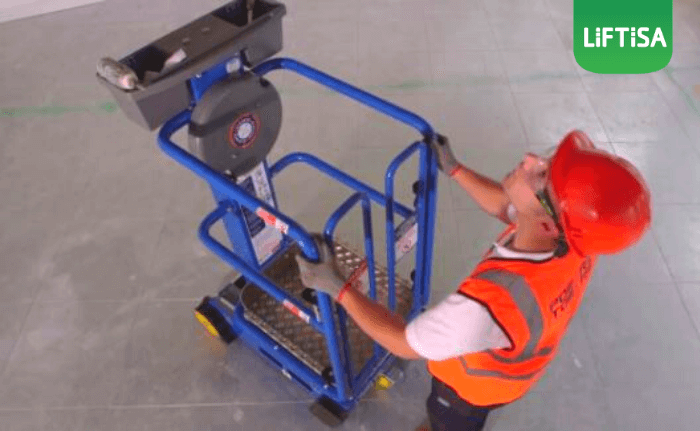
The case study clearly indicated that by using Pecolift lifting platforms, operators were able to work more safely, more efficiently and increase productivity by reducing working times. The Pecolift platform was also equipped to store tools and materials while working at height.
In addition, improvements were observed in the ergonomics of the workers and their health in general. The Pecolift could be easily maneuvered, stored, set up and maintained. Cleanliness was also improved.
Other advantages were the reduction of paperwork as daily stepladder permits were unnecessary. Increased quality of work, improvements related to efficiency, and improved satisfaction with operators. In addition, a reduction in accidents related to slips, trips, and falls from height was achieved. An improvement in workplace organization was also noted.
It was observed that the operators not only used the Pecolift in the German construction company’s projects, but also began to use the low-rise lifting platforms in other projects. This indicates that the operators themselves recognised the benefits of the Pecolift.
VIDEO: Benefits of using the Pecolift vs. Liftisa Ladder .
Features of the Pecolift
- Intuitive use and operation.
- Patented lifting mechanism*. Manual, no power required.
- Lightweight, easy to maneuver.
- Small footprint (0.99 m x 0.70 m).
- Unlimited lifting cycles. It can be used 24/7.
- Robust design for long-lasting without problems.
- Minimal operating costs.
- Maximum working height: 3.50 m
- Maximum platform height: 1.50 m
- Safe working load: 150 kg (1 person + tools).
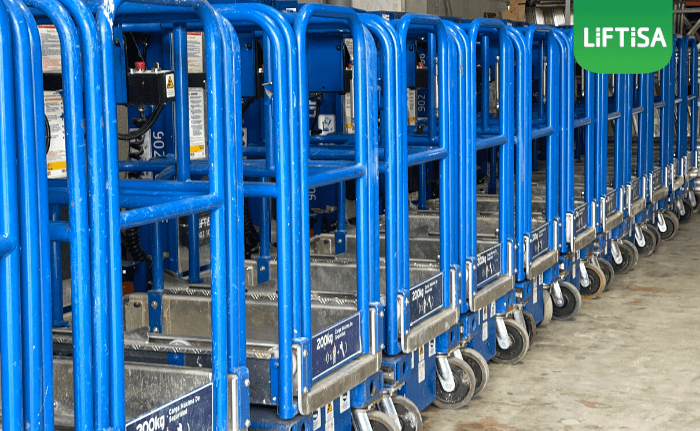
Far from reducing productivity, replace ladders with low-rise lifting platforms It significantly increases productivity due to reduced fatigue, height, and correct worker positioning. In addition, the worker has the ability to freely use both hands thanks to the tool trays and move around the lifting platform.
If you want to know more about this type of lifting platforms, at Liftisa we advise you.
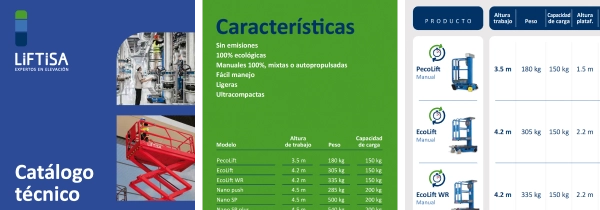
Download our catalog
You’ll be able to view all of our products and current offers, as well as the technical specifications and other services offered by LIFTISA so you have all the information you need for your project.