Low MEWP: Safe alternative to ladders


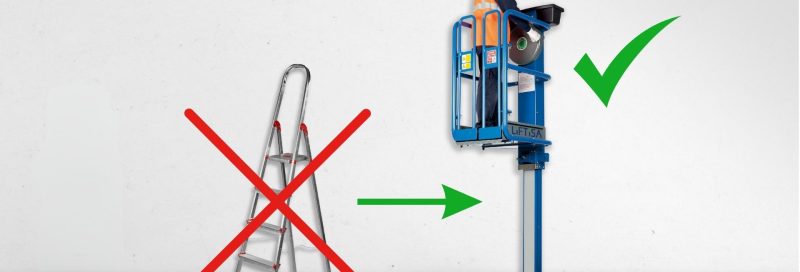
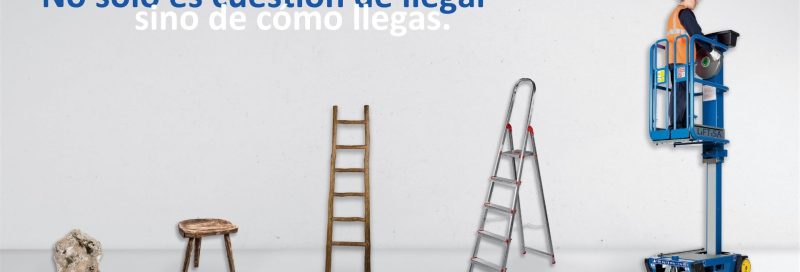
At Liftisa we are committed to low-rise MEWPs as a safe alternative to ladders. Did you know that every time you use a ladder, you increase the risk of an accident? And also, did you know that you run the risk of assuming very high costs related to construction injuries?
A large number of ladders are used in workplaces, as well as fixed and mobile scaffolding. The Construction Injuries They can lead to downtime, overtime, increases in insurance premiums, or fines for safety breaches for businesses. In addition, for the Injured Worker, it can mean expenses for medical treatment, time away from work, rehabilitation, and the possibility of needing to find a different position or job, or it can prevent you from working in the future. In the worst case, Accidents or misuse of ladders can lead to death of the operator. That is why, today, more and more companies are looking to replace ladders and scaffolding with safer systems.
Alternative to ladders
Safety and technology have come a long way since stairs were invented. For decades, since the introduction of the World’s first lifting platform in 1969, construction professionals have used both lifting platforms and scissor lifts, to carry out work at height more safely and efficiently. Even so, even the Traditional scissor lifts smaller in size (5-meter models) are not always best suited to complete low-height work indoors. Often, they are too big to fit in tight spaces and change positions easily. Even some models are too heavy to use on delicate floors and won’t fit in elevators to move between floors.

However, despite the fact that there are other alternatives available, the reality is that many professionals still use ladders for work at heights of less than 6 meters.
The rise of low-rise boom lifts
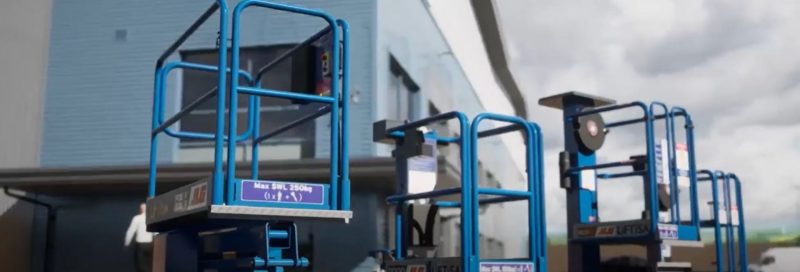
With fewer and fewer open spaces and narrower, taller buildings, there is a greater need for compact and lightweight lifts that can be moved between floors. This has promoted the emergence of Low Lift Platforms. Like the larger ones, low-rise platforms are designed to place people at height. Even if they are only a few feet off the ground.
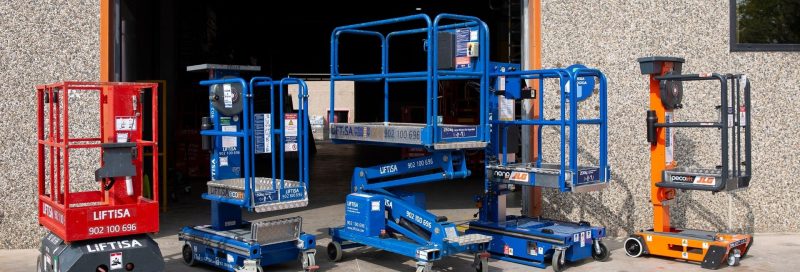
However, these types of platforms are designed with smaller wheels, offer a maximum working height of 6 meters and weigh less than 900 kilos. They can be used where a ladder or scaffold would previously be used due to ground or space weight restrictions.
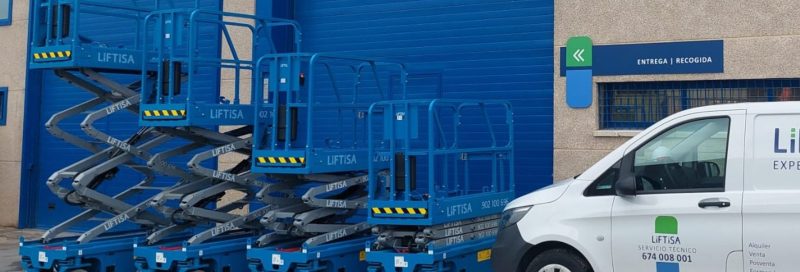
Low-rise lifting platforms are also designed to be moved in the work area, or between work areas, without the need for assembly or disassembly. This allows operators to access hard-to-reach areas that they might not be able to access with a traditional-sized platform lift. This allows multitasking with one machine to be safer, more productive, and more efficient.

Benefits: Safety, Productivity, and Efficiency
In addition to the productivity and efficiency benefits, low-rise lifting platforms are also designed to reduce strain on the body and decrease the risk of ergonomic injury caused by repetitive motions, such as going up and down a ladder to get tools or materials. It can be tiring work and lead to injuries associated with fatigue. Liftisa is a company concerned about the safety at work, and is committed to the elimination of ladders when there is another alternative.
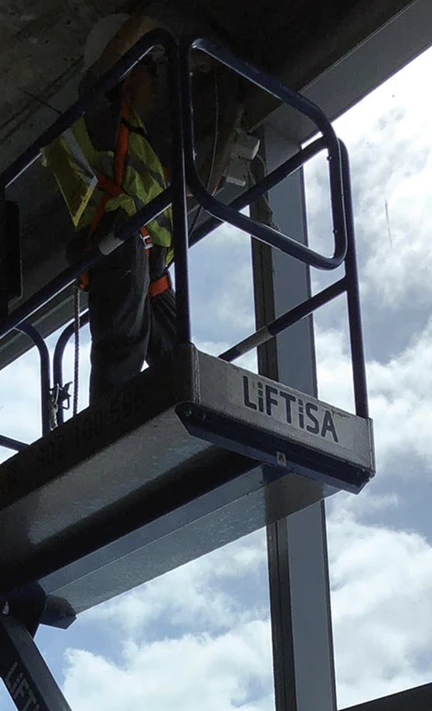
In addition, many low-rise lifting platforms are equipped with trays for storing tools and materials Allowing work to be done more efficiently by reducing up-and-down cycle times. Once lifted on a low-rise platform, operators can comfortably use both hands to work safely at height, a full 360 degrees. This is not the case with ladders. Workers often must use one hand for balance, leaving only one hand free to perform a task.
Where low-rise lifting platforms are used
Low-rise lifting platforms are primarily designed for indoor construction applications, such as placing mechanical and electrical components, installing HVAC and ductwork, or hanging drywall. And, since they are smaller and lighter than other types of MEWPs, they are also ideal for Finishing and equipment work, such as installing fire alarms or sprinkler systems, installing (or replacing) lighting, and placing roof panels. They also have the Size suitable for use in retail environments, retrofitting large screens and updating seasonal décor, as well as in industrial environments for production equipment maintenance.

These platforms, being smaller, can also be used to a large extent in general maintenance applications, such as painting and cleaning, in all types of buildings and facilities.
Its use is perfect for:
- Health facilities (hospitals, clinics and laboratories).
- Educational centers (schools and universities).
- Clean rooms.
- Data centers.
- Stores.
- Office complexes.
- Production plants.
- Airports.
- High-rise buildings.

How to choose a low-rise lift
Before selecting a low-rise lifting platform, the workplace should be considered and a number of questions answered:
- At what height do you need to work?
- What materials and tools will be needed to carry out the work at height?
- How many workers will be needed at height?
Once these questions have been answered, all the restrictions in the work area should be noted: narrow doors, elevators, sensitive floors and/or sensitivity to noise and emissions, etc. In addition, it must be Consider if any outdoor work is going to be done, or if the platform will only be used indoors. Finally, we must Look carefully at the platform’s specifications to ensure that it meets the site’s requirements.
- The most important are:
- Nominal operating capacity.
- Maximum platform height and working height.
- Ground weight and pressure specifications (for ground loading).
- Indoor/outdoor rating.
- Power source (manual, electric or mixed).
Liftisa has manual models that don’t need batteries, hydraulics, oil, or controls to operate. These Sustainable and eco-friendly low-rise lifting platforms are leak-free and operate quietly to work in environmentally sensitive areas, particularly where noise restrictions are in place. The Battery-powered electric or mixed platforms They are also available when operators have a high frequency of up and down cycles. These motorized MEWPs will improve productivity and efficiency in these types of applications.

The Future of Low-Rise Platforms
Advances in these smaller MEWPs have focused solely on improving the operator experience through productivity-focused features, such as work trays for storing tools at height.
Future attachments will focus on helping operators complete more tasks, such as lifting pipes and wall panels or pulling wires. And as demand continues to rise, the Product ranges are expanded to include more height, weight, and platform configurations for operators to fit into even smaller and narrower areas, such as aisles barely wide enough for one person and/or between racking systems and roof shingles.
Looking at what is needed to carry out work at low heights and comparing it with what can be achieved with a small MEWP, at Liftisa we are convinced that it is possible to replace ladders with this type of lifting platform.
Market opportunities for these types of platforms are increasing rapidly, as it is a machine that can reduce the risks associated with working at height and worker fatigue while promoting more ergonomic working positions.
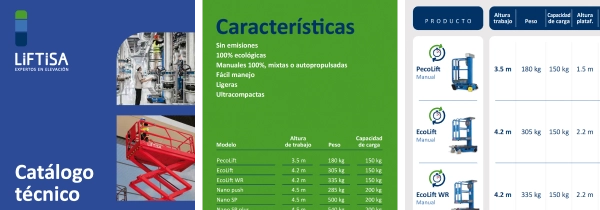
Download our catalog
You’ll be able to view all of our products and current offers, as well as the technical specifications and other services offered by LIFTISA so you have all the information you need for your project.