Risk prevention in working at height

With 30 years of experience offering solutions for working at height, at Liftisa, our main purpose is safety at work.
Not only do we offer machines for rent and sale to carry out work at height, but we also provide our customers and users of the machines with the specific training that is needed to carry it out in the best possible way.
Construction-related falls from heights are between 8 and 10% of fatal cases in workplace accidents.
We innovate every day to improve safety, provide the right solutions in each case and avoid accidents.

Working at height and rope access
Work at height is work that is carried out at a height greater than two metres.
This can be maintenance, repair, construction, or restoration work on buildings.
The following lifting solutions are used for this purpose:
- Scaffolding
- Wheelbarrows
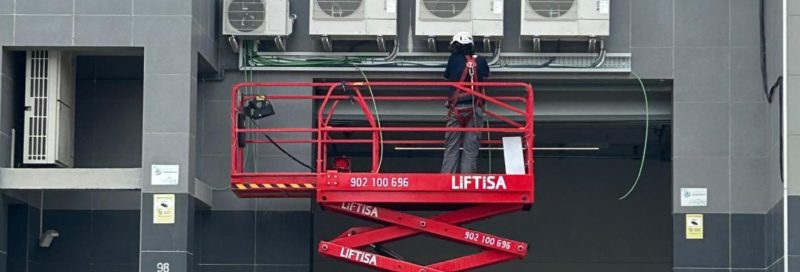
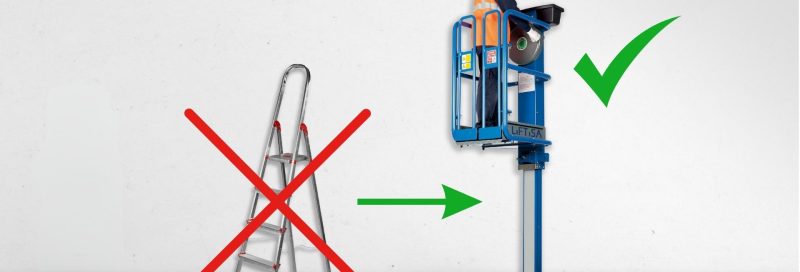
- Single-person, outdoor, and indoor platforms
- Cranes
- Pruning machines
We are experts in the rental, sale and after-sales of lifting platforms for people and material. We have a wide range of products for working at height, as well as maintenance, repair and training services in the use and handling of our entire range of products.
Vertical work is access and positioning techniques using ropes, anchors and devices, together with fall arrest systems and other specific accessories to be able to access and carry out a certain work at a certain height, or at depth.
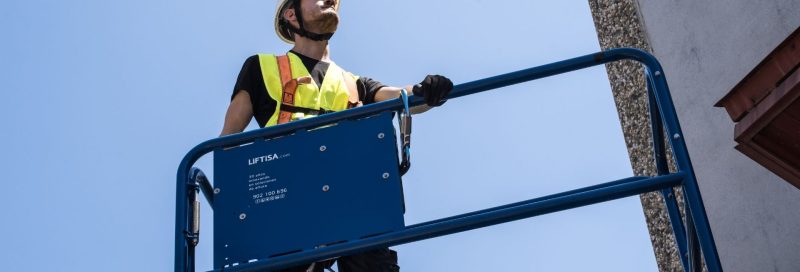
All work at height must always be carried out with the help of protective equipment and materials.
The company responsible for the work must provide the appropriate solutions in each case in order to avoid accidents.
Current regulations
In 2004, Royal Decree 1215/1997 was amended and replaced by Royal Decree 2177/2004 on work equipment, with regard to equipment for carrying out temporary work at height.
The techniques of access and positioning by means of ropes (vertical work) were introduced and the conditions of use were established, also referring to the content of the training that the professionals who use them must have.
It will be the risk assessment of the work to be carried out that will determine the adequacy of the application of access and positioning techniques by means of ropes.
Risks and risk factors
The use of work equipment by workers to carry out temporary work at height is the key to avoiding accidents.
The most common accidents are:
- Falls at different levels
- Falling materials or objects in their handling on people and/or goods
- Cuts or wounds of various kinds from the use of tools and machinery
- Falls at the same level
- Particle projection
- Burns
- Particulate inhalation
- Direct or indirect electrical contacts
- Explosions in the presence of explosive atmospheres
- Ergonomic risks
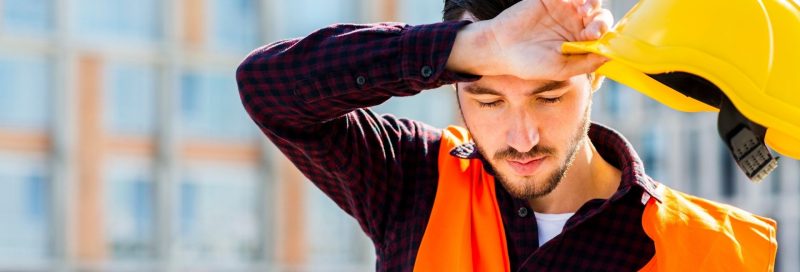
- Heat stress
Other factors to take into account are: the stability of the place, atmospheric factors and personal factors of the worker.
All of them can directly influence an accident.
Three pillars: safety, training and reviews
The prevention and protection measures are specified in the description of the work procedures in which the specific way of carrying out each of the activities is included.
They should be chosen in such a way as to eliminate, or reduce as much as possible, the risks described above.
Safety
Work procedures must be developed for all activities and/or tasks to be carried out. These procedures must include the most suitable preventive and protective measures so that work at height can always be carried out safely for the worker.
Training
Training is an essential element in risk prevention to comply with current legislation on the handling of lifting platforms: Royal Decree 1215/1997, Law on the Prevention of Occupational Risks 31/1995 and the UNE 58923:2020 Standard. This Certification must be renewed every three years.
It must always be approved and in accordance with the needs of the user company.
The reviews
For the use and handling of any lifting platform, scaffolding or forklift, it is necessary to comply with the following regulations:
Maintenance established by the manufacturer
According to the UNE 58921:2017 Standard, Machinery Maintenance must be carried out to check its effectiveness and safety.
To do this, the instructions in the Manufacturer’s Manual and the periodicity indicated must be followed.
Annual security reviews
According to the UNE 58921:2017 Standard, Annual Safety Reviews must be carried out, to ensure the conformity of the operation according to the manufacturer.
The annual safety reviews are the periodic, structural, functional and operational checks of resistance and conservation, to guarantee the maximum performance of the machine according to its design and manufacture, as well as the safety and health of the people who operate with them.
Technical Inspection of Machinery
According to the UNE 58921:2017 Standard, in the event of any accident, each lifting platform must prove that it has passed the corresponding Technical Inspection every 3 years, accredited by qualified technicians, always independent and without any link to the companies that own the machines.
If you have any questions, please contact us. We will help you with everything you need, and you will be able to have your entire company and workers under the current and necessary safety regulations.
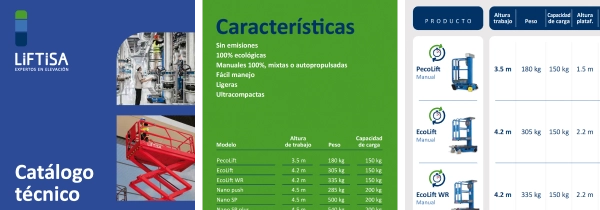
Download our catalog
You’ll be able to view all of our products and current offers, as well as the technical specifications and other services offered by LIFTISA so you have all the information you need for your project.